In a nutshell
- The operator states plainly that ice thickness is not guaranteed until early in the year.
- River water makes it nearly fresh, so it freezes near zero rather than below minus one.
- Ice grows downwards from underneath, faster when it is cold and thin.
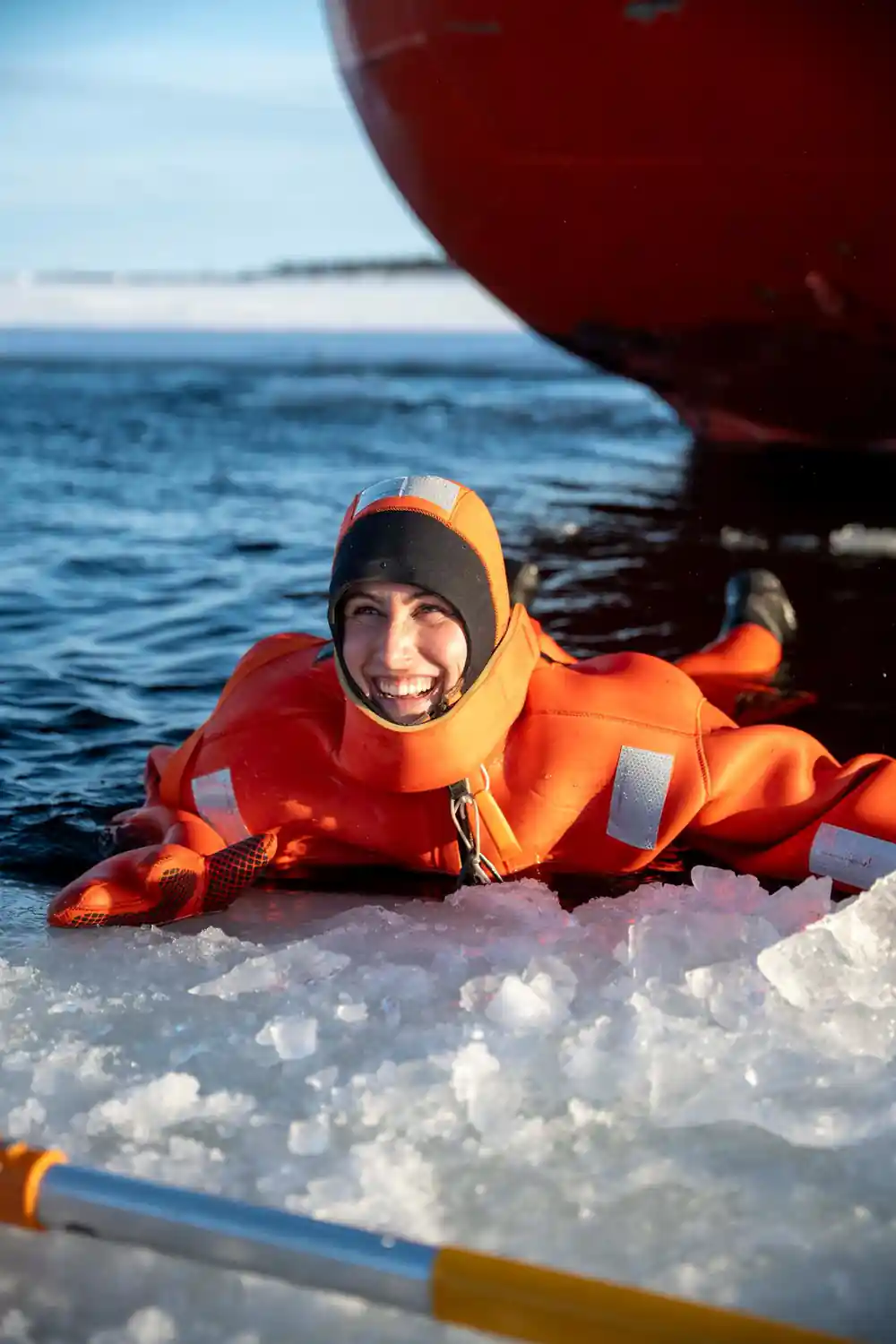
- The sailing and the swim happen whether or not the ice walk is on.
The caveat first
The operator says, in the small print of the listing, that ice and its thickness are not guaranteed until early January, and that walking on the ice may not be available before then. That is a straightforward and honest sentence and it is the single most useful piece of information on the whole booking page.
It is worth taking seriously rather than treating as boilerplate. Standing on a frozen sea is, for many people, the thing they came for. Booking it in the first half of December means booking a cruise and a swim with a reasonable chance of the ice walk, not a certainty of it.
Nothing else about the day depends on this. The ship sails, the ice breaking happens, the swim happens. The walk is the part that waits for the sea.
Why this sea freezes at all
Most of the world's sea does not freeze, and the parts that do are generally a long way further north than this. The Bothnian Bay manages it because of what is in the water rather than where it is.
Several substantial rivers empty into the top of the Gulf of Bothnia, and the bay is shallow and enclosed enough that the fresh water does not simply disperse. The result is water that is barely brackish, with a salinity a small fraction of the open ocean's.
Salt is what stops sea water freezing. Dissolved salts interfere with the formation of the ice lattice, so full-strength ocean water has to be chilled to nearly minus two degrees before it will freeze at all, and even then it forms a slushy, salt-rejecting mess. Water this close to fresh freezes at close to zero, and it forms proper ice.
So the Bothnian Bay behaves less like a sea and more like an enormous shallow lake, which is exactly why you can walk on it.
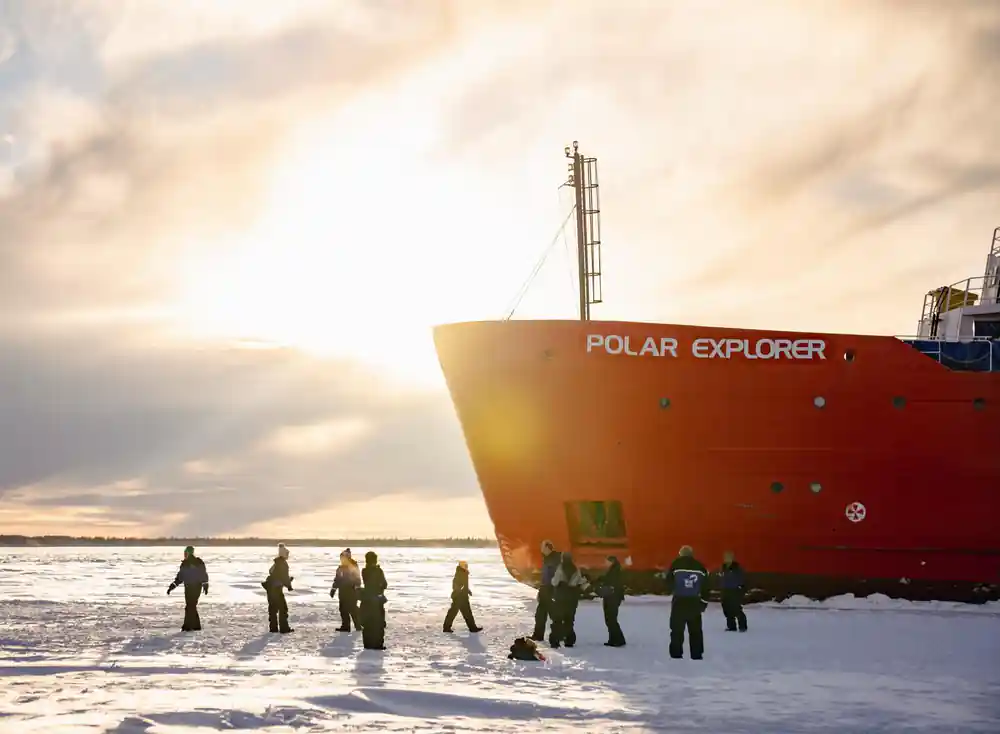
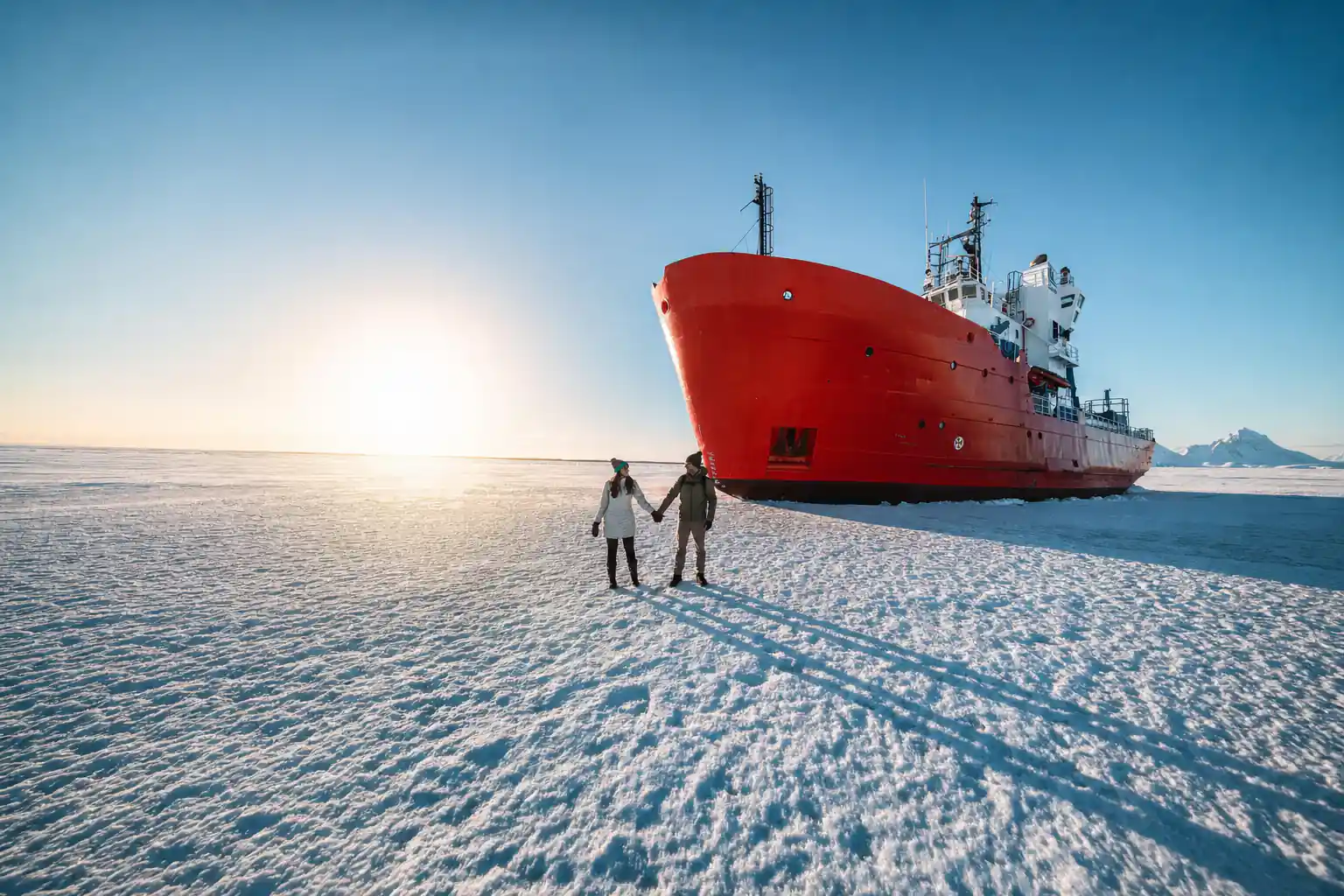
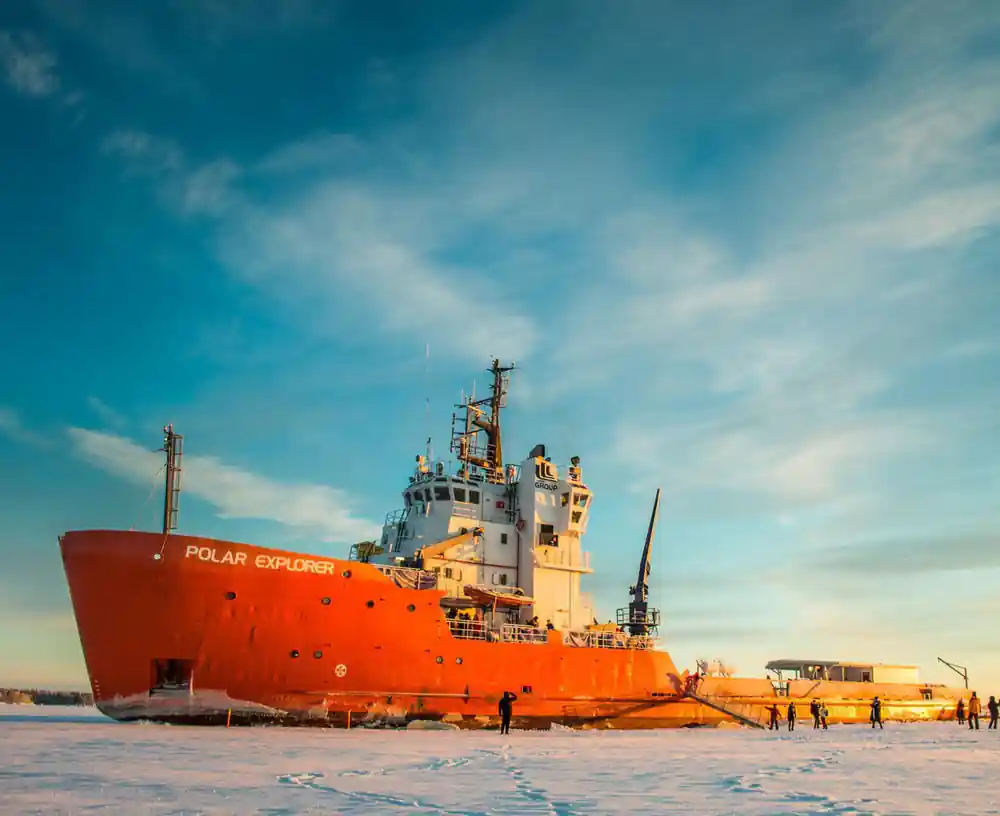
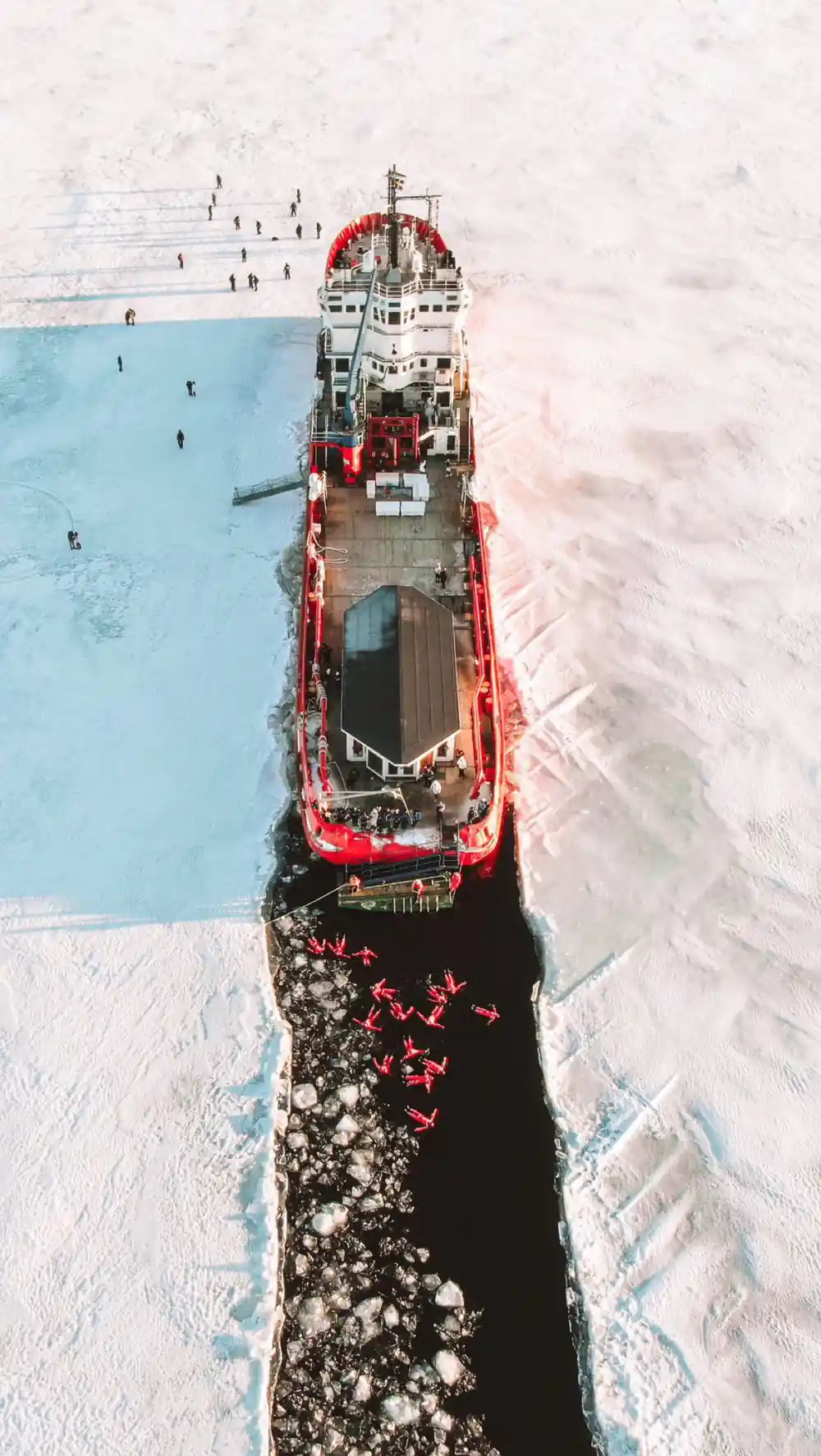
Passengers on the sheet beside the hull
How the ice thickens
Once a sheet has formed, it grows downwards from its own underside. The water beneath is at freezing point, the air above is far colder, and heat escapes upwards through the ice; where it leaves, more water freezes onto the bottom of the sheet.
This has a self-limiting quality that is worth understanding. Thin ice is an excellent conductor and grows fast. Thick ice insulates the water below it from the cold air above, so growth slows as the season goes on. A sheet can go from nothing to a walkable thickness quite quickly in a cold snap and then take weeks to double it.
Snow slows it down further, because a layer of snow on top is a very good insulator and effectively puts a blanket over the whole process. A cold, clear, snowless December builds ice much faster than a mild snowy one, which is why the answer to when the walk becomes reliable is a range rather than a date.
By the second half of the winter the sheet in this bay is thick, stable and load-bearing over large areas, which is why later in the season is the safer bet.
What it is like, and whether it is safe
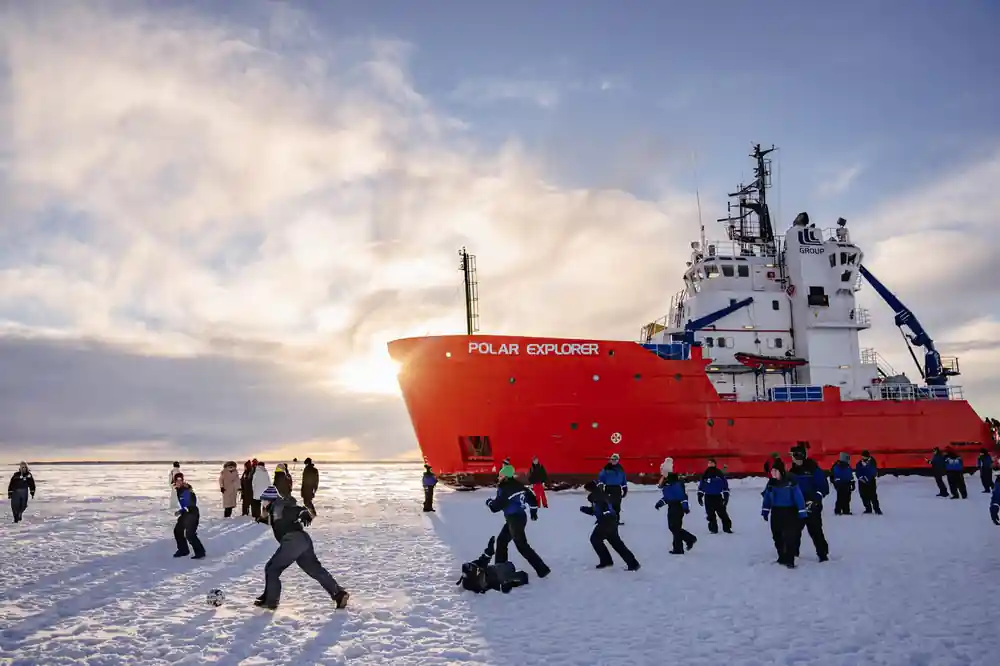
Standing on a sea is a genuinely strange sensation, and the strangeness is intellectual rather than physical. Underfoot it is simply hard, slightly uneven, usually covered in wind-packed snow, and completely solid. Nothing moves. What makes it odd is knowing what is beneath it.
The ship gives you a reference the ice alone would not: it is sitting in a channel it has broken, so you can walk to the edge and see the sheet in cross-section, with black water at the bottom of it and blocks the size of tables tipped over on the margins. That is the moment most people take in what they are standing on.
As for safety, this is not an amateur judgement being made on the day. The crew work this sea all winter, the ship has just broken the sheet and therefore knows exactly what thickness it is dealing with, and the walking area is defined and supervised. The reason the operator hedges about early season availability is precisely because they do not improvise: if the sheet is not ready, the walk does not happen.
Which is the correct trade. An ice walk that is sometimes cancelled is a great deal better than one that is never cancelled.
Near zero
The freezing point of the Bothnian Bay, because river water keeps it barely salt. Full-strength ocean water has to reach nearly minus two before it will freeze.
What the sheet looks like from the air
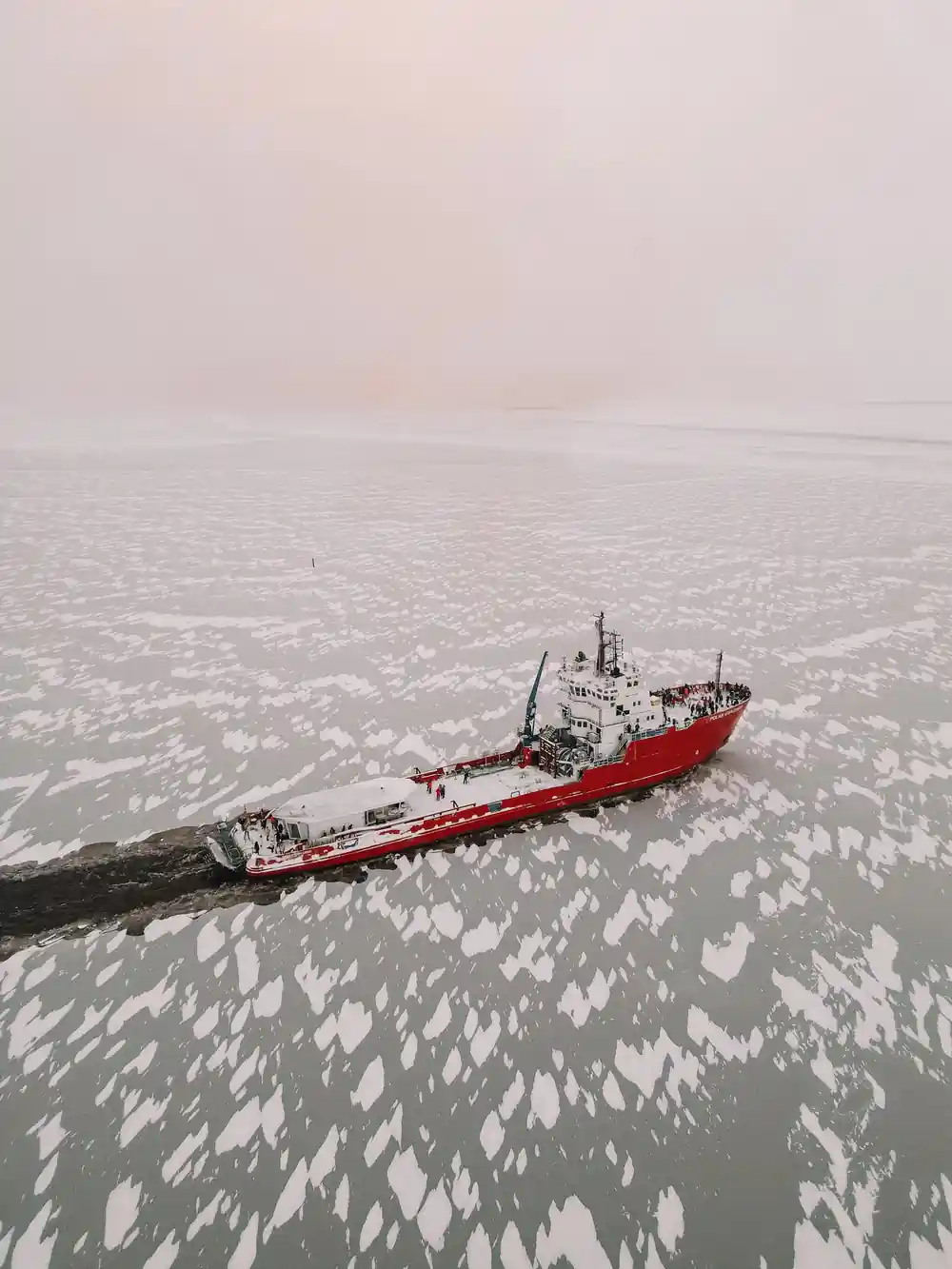
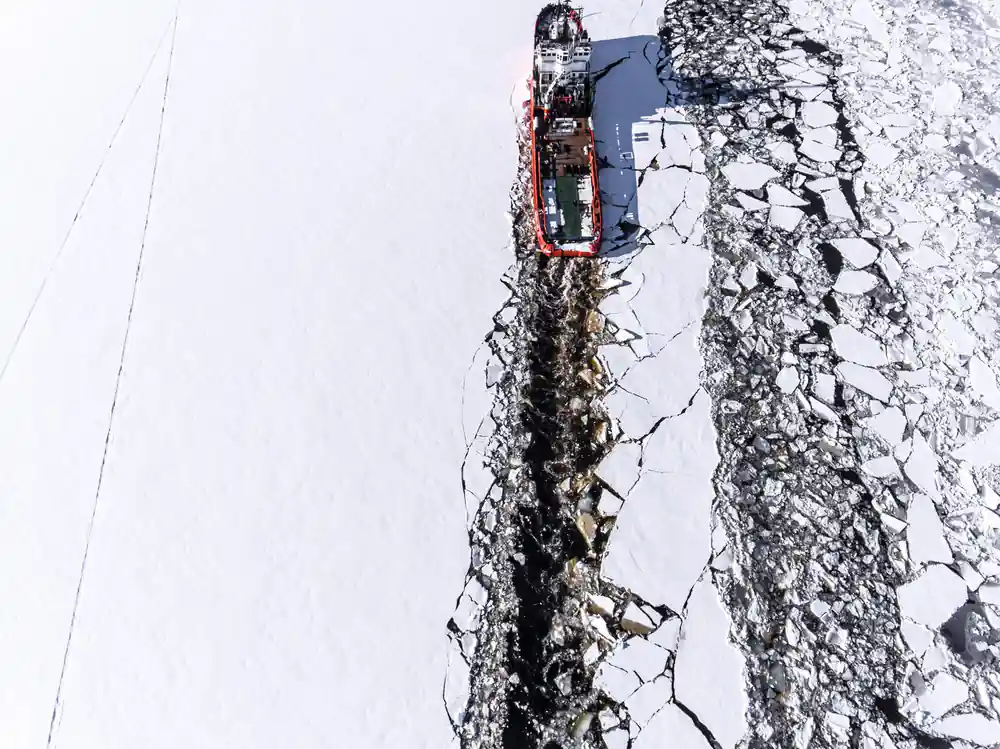
The operator's own photographs include several taken from directly above, and they explain the ice better than any description does. The intact sheet reads as flat white, marked with long thin cracks that have refrozen. Through the middle of it runs the ship's channel: not a clean line but a wide lane of tumbled blocks, pale where they have turned over to show their undersides and dark where open water is still showing.
You can see the history of the winter in those images. Older ice is thicker and holds snow evenly. Newly refrozen leads are darker and smoother, because they have not had time to accumulate anything on top. Ridges form where two sheets have pushed against each other and buckled, and they stand up as low white walls that run for a long way.
None of this is visible from the deck, where the sheet is simply a white plain to the horizon. It is worth looking at the aerial photographs before you go, because it turns the flat white surface you will be standing on into something with a structure and a history.
The sailing and the swim run whatever the ice is doing
from US$375Live tour guide